
What happens when 11 farm animal crafts for kids stop being separate projects? They become a little working farm children can move, change, and play with.
A farm animal craft can be more than a paper cow, a cardboard pig, or a chicken made from a few scraps of paper. Give those animals somewhere to go, and suddenly the craft table becomes a little barnyard.
That is the idea behind these farm animal crafts for kids. Instead of making one animal and putting it aside, children can gradually build a small farm of their own, adding animals, a barn, a coop, a pasture, a pond, and stories about what happens there.
Along the way, there are real things to notice and talk about: why some animals need shelter, why others spend time grazing outdoors, what makes a chick different from a hen, and why not every animal on a farm lives in a barn.
The crafts become a simple way to introduce those ideas without turning playtime into a lesson.
So gather some paper, cardboard, glue, and whatever other basic supplies you already have. Then let the barnyard take shape, one animal at a time.
Get little hands comfortable with clay through Clay Crafts for Kindergarten Kids That Are Easy, Fun, and Great for Little Hands.
What Actually Belongs in a Barnyard?

A farm is not automatically a barn, a field, and a collection of animals standing together.
Farm animal is a broad everyday term, and what you find on a farm depends on the kind of farm, its location, climate, and what the farmer raises.
Cattle, pigs, sheep, goats and poultry are common examples of livestock, while other farms may keep animals such as llamas, alpacas or rabbits. The CDC likewise describes several of these as common farm animals rather than suggesting that every farm has the same mix.
That matters when building a pretend barnyard with children. The goal isn’t to create a miniature farm that looks exactly the same everywhere.
It’s to give each animal a sensible place and a reason for being there.
The little barnyard you’re building
For these crafts, think of the farm as a small collection of spaces rather than one big animal area:
- Livestock areas: cattle, sheep, goats and pigs may be kept in different combinations depending on the farm.
- Poultry areas: chickens and other domestic birds may have a coop, run or other enclosed space.
- Pasture or grazing areas: animals such as cattle, sheep, goats and horses may use pasture or other outdoor areas for forage.
- Sheltered areas: animals may need barns, sheds, shelters or other structures for protection and management; the exact setup varies considerably.
- Water and feeding areas: access to suitable food and safe drinking water is part of responsible livestock management.
And here’s an important distinction for children: a barnyard is not the same as a pasture. A barnyard is generally an area associated with the farm buildings and animal handling, while a pasture is land used for grazing or forage. A farm may have both, but they serve different purposes.
So when your child builds this little barnyard, don’t worry about putting every animal beside the barn.
Let the cow wander into the pasture, give the chickens a coop, create a sheltered spot for another animal, or add a small fenced area. That simple arrangement can lead to a much better question than “What color should I make my cow?”:
“What does this animal need, and where would it make sense for it to be?”
That is where a farm animal craft starts becoming a small lesson in how farms actually work.
Bring some seasonal fun to craft time with 20 Easy Apple Crafts for Kids to Make at Home.
Animal Crafts
1. Cow — The Animal Children Often Associate With the Farm

Materials: Paper or cardstock for the cow, scissors, glue, markers or crayons, plus green paper or cardboard for the pasture. Optional: extra paper or cardstock for a smaller calf.
As your child makes the cow, this is a good moment to introduce a simple bit of farm vocabulary they will hear again and again.
Cattle is the general name for these animals.
An adult female is a cow, an adult male is a bull, and a young one is a calf. So when a child calls every cattle figure a “cow,” you can gently explain that cow describes a particular member of the group, not all cattle.
Then bring that idea into the pretend farm.
Ask, “Where do you think your cow would spend the day?”
Rather than placing it automatically inside the barn, give it a little pasture made from green paper or cardboard.
Cattle commonly graze on grasses and other forage, and farmers may also provide forage such as hay depending on the animal and the farming system.
You can keep the conversation simple:
“Cows eat plants like grass. What could we put in our pasture for the cow to eat?”
That one question turns the craft into more than cutting and gluing. The child is beginning to connect the animal, what it eats, and the place where it lives.
If you want to extend the play, make a smaller calf and ask the child to match it with the cow.
Now the finished craft has introduced three useful ideas, cow, calf and cattle, without making the activity feel like a lesson.
2. Chicken — Turn Craft Into a Conversation About Eggs and Chicks

Materials: Paper or cardstock for the chicken, scissors, glue, markers or crayons, plus a small piece of cardboard or folded cardstock for the coop or nesting area and small white paper scraps for pretend eggs.
A chicken is one of the easiest animals to recognize in farm animal crafts for kids, but it also gives you a chance to teach a few words children often mix up: hen, rooster, chick, and egg.
As your child makes the chicken, explain that an adult female chicken is a hen, an adult male is a rooster, and a young chicken is a chick. Then let the child make a small coop or nesting area for the chickens.
You can ask:
“Where should the chickens sleep? Where would you put the eggs?”
That question gives the finished craft somewhere to go and something to do. The child can place the hen in the coop, add pretend eggs to the nesting area, and later move the chicks around the farm.
You can also point out that an egg is not automatically a chick. A chick develops from a fertilized egg under the right conditions; the eggs people commonly collect for food are not necessarily fertilized.
It is a small distinction, but a useful one when children begin asking where chicks come from.
With these farm animal crafts for kids, the goal isn’t just to make a chicken that looks right. It’s to use the finished animal to start a simple conversation about what it is, where it lives, and what happens on a real farm.
For a tactile project that encourages children to bend, twist, and create, try Easy Pipe Cleaner Crafts: Fun Projects That Spark Kids’ Creativity and Encourage Sensory Learning.
3. Pig — Make the Mud Part of the Story

Materials: Pink paper or cardstock for the pig, scissors, glue, markers or crayons, plus brown paper or cardboard for the muddy area. Optional: washable paint and blue paper for water.
The pig is a good opportunity to correct another familiar farm-animal misconception. Pigs don’t wallow in mud simply because they are dirty.
Pigs have limited ability to cool themselves through sweating, so wallowing in mud can help them lose heat. Mud can also provide some protection from the sun and biting insects.
As part of your farm animal crafts for kids, make a small muddy area beside the pig using brown paper, cardboard, or washable paint. Then ask:
“Why do you think the pig would choose this spot on a hot day?”
Let the child move the pig into the mud and explain that the mud isn’t a sign that the animal has done something wrong. It can actually serve a useful purpose.
You can take the conversation one step further by asking what the pig might need besides a muddy area: food, water, shade, and suitable shelter.
Now the craft is doing something more useful than producing another pink paper pig. It is helping the child understand that animal behaviors often have a reason behind them.
4. Sheep — Look at What the Animal Grows, Not Just What It Looks Like

Materials: Paper or cardstock for the sheep, scissors, glue, markers or crayons, plus cotton balls, yarn, wool, or torn white paper for the fleece.
A sheep craft almost begs for cotton balls, but the interesting part isn’t making the sheep fluffy. It is helping a child understand what that fleece is actually for.
Sheep grow wool, a natural animal fiber produced from their fleece. In many sheep breeds, the fleece is removed by shearing, usually as part of routine animal care.
The wool can then be cleaned, sorted and processed into fibers used to make textiles.
As the child adds the woolly covering to the sheep, you can make the connection to things they may already know:
“This came from an animal. What things do you have that are made from wool?”
A sweater, blanket, sock or other textile can become the starting point for a simple animal-to-material conversation: the sheep produces a fleece, the fleece is collected and processed, and the resulting wool can eventually become something people use.
It is also worth explaining that not every sheep is raised primarily for wool.
Breeds and farming systems differ, and sheep may be kept for wool, meat, milk, or combinations of these purposes.
That makes the fluffy sheep more than decoration. The child gets to see how an animal can be connected to a material that appears in everyday life.
Turn little handprints into a playful Halloween keepsake with How to Make Easy Spider Handprint Crafts for Kids Using Simple Supplies.
5. Goat — Give This One Its Own Kind of Space

Materials: Paper or cardstock for the goat, scissors, glue, markers or crayons, plus paper for leaves, twigs and shrubs and cardboard or craft sticks for a small fence.
The goat can help children notice that a farm does not have one standard layout where every animal stands beside the barn.
Goats are kept in many parts of the world for different purposes, including milk, meat and fiber, depending on the breed and farming system. They also have different feeding habits from cattle.
Goats are known as browsers, meaning they naturally seek out leaves, shoots, shrubs and other vegetation rather than relying only on grass.
Give the paper goat a small fenced area with some leaves, twigs or shrubs made from paper. Then ask:
“What could we put here for the goat to look for?”
That gives the child a reason to think about the animal’s surroundings instead of simply deciding where the craft should stand.
You can also explain that real goats still need appropriate feed, clean water, shelter and safe space.
Their enclosure will look different from farm to farm, so the little barnyard you’re building doesn’t have to follow one fixed picture of what a farm is supposed to look like.
6. Horse — A Farm Animal Doesn’t Always Have to Produce Something

Materials: Paper or cardstock for the horse, scissors, glue, markers or crayons, plus cardboard or craft sticks for a stable, paddock, or simple fence.
The horse gives you a different question to explore: What is an animal’s role on a farm?
Unlike a sheep whose wool may become a useful material or a dairy cow whose milk may enter the food system, a horse does not have one universal “farm purpose.”
Around the world, horses have been used for transport, pulling and agricultural work, while many are now kept primarily for riding, recreation, sport or breeding.
So avoid telling children that “horses work on farms.” That is true in some settings, but it is not true of every horse or every farm.
Instead, let the craft introduce the idea that the same animal can have different roles depending on where and how people keep it.
Give your horse a stable or paddock, then ask:
“What do you think this horse does on this farm?”
Maybe the child decides it helps move something. It t is used for riding, or it simply lives there.
That open-ended question is valuable because there isn’t one pretend answer you have to force on them. It encourages the child to understand that farms around the world do not all look or operate the same way.
Another sweet fall keepsake is How to Make Pumpkin Footprint Art with Kids for an Easy Fall Keepsake They’ll Treasure.
7. Duck — Let the Child Decide What the Water Is For

Materials: Paper or cardstock for the duck, scissors, glue, markers or crayons, plus blue paper or cardboard for the pond and a small piece of paper or cardboard for the duck’s outdoor area or coop.
A duck gives your farm animal crafts for kids a chance to introduce something that is easy to overlook: water is part of an animal’s environment, but the way an animal uses water matters too.
Make a small pond from blue paper or cardboard and place the duck nearby. Ducks are poultry, and many domestic ducks are comfortable around water, but a pond is not a requirement for keeping ducks.
They still need reliable access to clean drinking water, and their housing and outdoor area depend on the particular farming system.
You can use the craft to explain the difference between drinking water and a swimming area. Ducks can use water for behaviors such as bathing and preening, but they also need clean water for drinking.
Their feathers have a natural water-resistant quality that helps them stay relatively dry when they are in water.
Ask the child:
“Does our duck need the pond all the time, or does it need clean water somewhere else too?”
That question opens the door to a useful idea: animals don’t simply need a place to live. They need an environment that meets their particular needs.
The child can then decide whether the duck belongs beside the pond, near the coop, or both. The little farm starts becoming a place with different spaces for different reasons.
8. Donkey — The Farm Animal That Has Helped People Work in Many Parts of the World
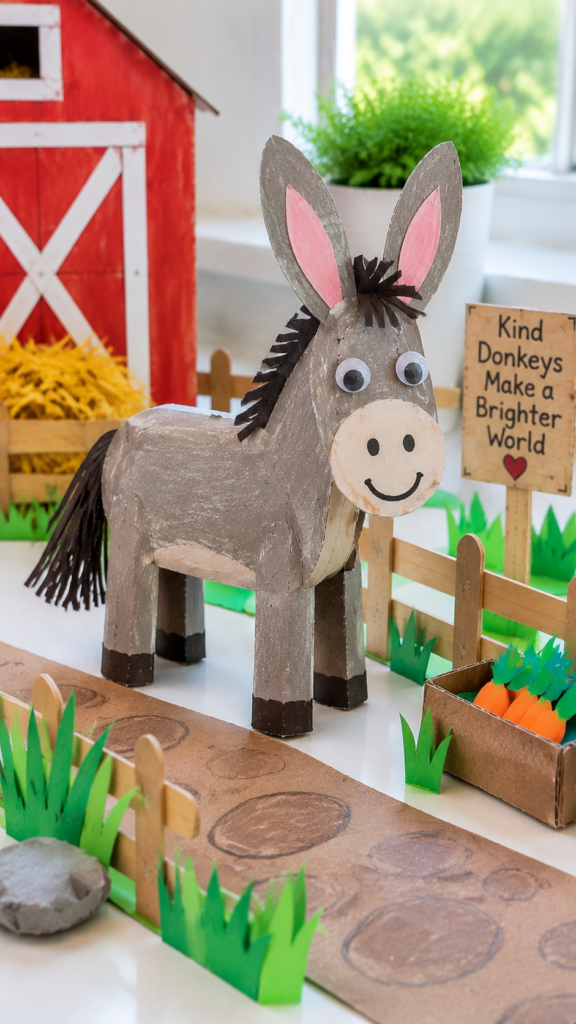
Materials: Paper or cardstock for the donkey, scissors, glue, markers or crayons, plus cardboard or paper for a simple path or paddock. Optional: extra cardboard or paper to make a small cart.
The donkey brings an international perspective to your farm animal crafts for kids because donkeys have played important working roles in rural communities across many regions, particularly where people rely on animals for carrying loads or transport.
While making the donkey, help the child notice how it differs from a horse. Donkeys generally have longer ears, a different body shape and a thicker mane, and they are a separate species from horses.
Donkeys and horses can mate and produce a mule, but the two animals are not the same species.
You can also explain that donkeys have historically been used to carry loads, pull carts and support agricultural or transport work, although the role of a donkey today varies greatly by country and community.
Give the donkey a simple path or paddock rather than placing it inside the barn.
Then ask:
“What job might our donkey have on this farm?”
The child might decide that it carries something, pulls a small cart, or simply lives on the farm. That keeps the activity accurate without suggesting that every donkey has the same job.
Save those childhood creations and memories together with How to Create a DIY Memory Box for Kids That Preserves Their Favourite Childhood Moments.
9. Rabbit — Does a Rabbit Really Belong on Every Farm?
Materials: Paper or cardstock for the rabbit, scissors, glue, markers or crayons, plus a small cardboard box, folded cardstock, or recycled carton for the hutch or enclosed area.
The rabbit is worth including precisely because it makes children stop and think about the phrase “farm animal.”
Rabbits can be raised on farms, but seeing a rabbit in a farm-themed picture does not automatically make it livestock.
Depending on the setting, rabbits may be raised for meat, kept for breeding or fiber production, kept as companion animals, or simply exist as wild animals around rural areas.
That makes the rabbit a useful opportunity to introduce the idea that an animal’s category depends partly on how people keep and use it.
Give the rabbit its own small hutch or enclosed area rather than automatically putting it inside the barn with the larger livestock.
While the child places the rabbit, ask:
“Why do you think this rabbit needs its own space?”
You can then talk about the fact that rabbits need appropriate food, clean water, shelter and protection from hazards.
Their housing should also allow normal movement and behavior.
That little conversation takes the craft beyond “Here’s our farm rabbit.” It teaches children to look at an animal and ask a better question:
“What does this animal need?”
That is a much more useful way to build the rest of the barnyard.
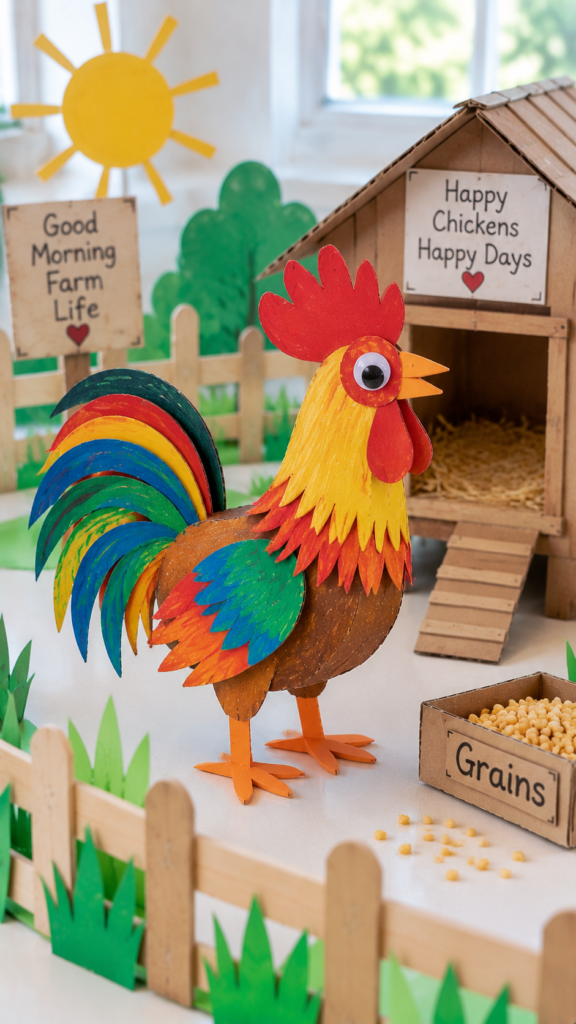
10. Rooster — Use the Morning to Start the Farm Story
Materials: Paper or cardstock for the rooster, scissors, glue, markers or crayons, plus cardboard or paper for a small coop, perch, or farm area where the rooster can stand.
Once the rooster is finished, give it a job in the child’s little farm story: it can mark the beginning of the day.
You might say:
“It’s morning on our farm. What do you think happens first?”
The child can decide what happens next. Perhaps the rooster is outside while the chickens leave their coop. The cow moves toward the pasture. Someone checks the animals’ water. Another animal stays in its shelter.
This gives the child a reason to move the different crafts around instead of leaving them where they were made. The rooster becomes the starting point for a story that brings the whole barnyard together.
There is one detail worth getting right, though. The familiar idea that “the rooster wakes everyone up” comes largely from stories, cartoons and traditional farm imagery.
Roosters do crow, and they can crow throughout the day, but they do not have a special job of waking every animal or person on a farm.
You can turn that into a fun little conversation with your child:
“Do you think the rooster really wakes up the whole farm, or is that something we often hear in stories?”
It is a small distinction, but it teaches children that things they hear in stories aren’t always rules about how real animals behave.
Turn Bible storytelling into hands-on learning with Daniel and the Lion’s Den Craft: An Easy Bible Activity That Helps Kids Remember the Story.
11. Barnyard Dog — Give the Finished Farm a Helpful Extra Pair of Paws
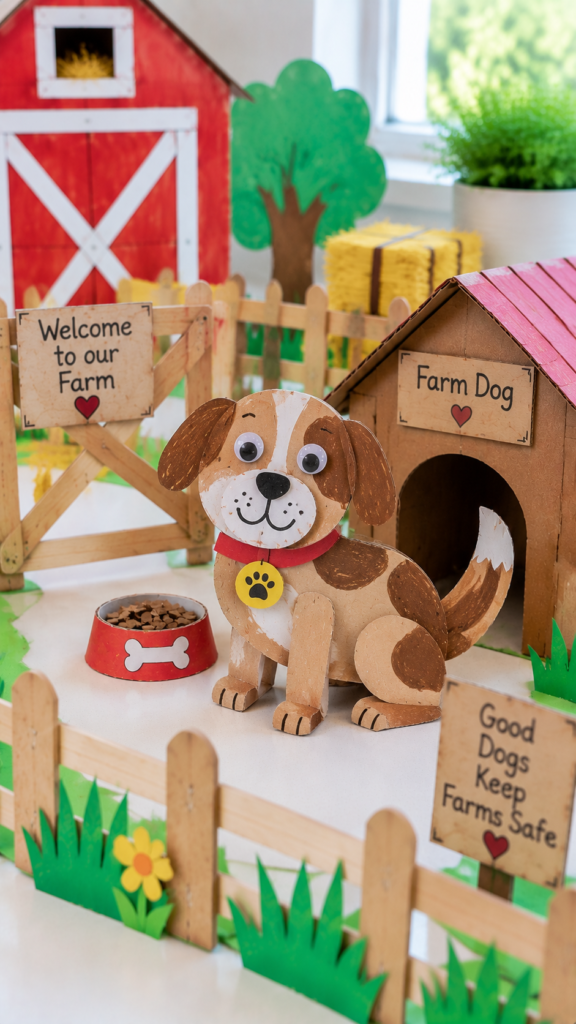
Materials: Paper or cardstock for the dog, scissors, glue, markers or crayons, plus cardboard or paper for a simple gate, fence, or farm area where the dog can carry out its pretend role.
The dog is a good final addition because it gives the little farm another character with a job to do.
But there is an important distinction to make: not every dog kept on a farm is a livestock guardian, and not every farm needs a working dog.
Some dogs are trained to herd livestock, while livestock guardian dogs are bred or trained to stay with and protect livestock from predators.
Other dogs on farms may simply be companion animals.
As you finish this last craft, you can ask:
“What job should our dog have on this farm?”
Perhaps your child decides the dog helps move sheep, stays near the animals, or simply lives with the farmer. Place it near the part of the barnyard that matches its pretend role.
This is also a nice chance to explain that a dog’s job depends on the dog, the training, the animals being kept, and the needs of the farm.
A Border Collie working sheep, for example, is doing something very different from a livestock guardian dog protecting a flock.
Now the dog isn’t just another animal added to the collection. It gives the finished barnyard another layer of purpose, movement, and storytelling.
For more hands-on activities that make learning feel like play, see Easy DIY Sensory Crafts for Kids That Boost Learning Through Play.
Turning the Finished Barnyard Into Pretend Play

Once all 11 animals are finished, don’t pack them away. This is where the farm animal crafts for kids become a pretend-play farm that the child can actually use.
Set the animals around the barnyard and start with a simple morning scene.
“The farm is waking up. What happens first?”
Your child might move the rooster outside, take the chickens from their coop, move the cow toward the pasture, or decide that the horse needs to stay in its paddock.
Then introduce small situations that make the child think about each animal.
“The cow is hungry. Where should she go?”
“The chickens have laid eggs. Where can we find them?”
“It’s very hot today. Where could the pig cool down?”
“The goat is looking for something to eat. What could we put in its space?”
“The duck needs water. Where should we take it?”
Now the child isn’t simply moving paper animals around.
They’re using the things they learned while making them: the cow has a pasture, the chickens have a coop, the pig has a place to cool down, and the duck needs access to water.
You can also let the child become the farmer. Give them a few simple jobs:
- Check that each animal has the right space.
- Move the animals to where they need to be.
- Pretend to provide food and water.
- Check on the chickens.
- Take the horse to its paddock.
- Decide where a new animal should stay.
Then let the child change the story.
“A new animal has arrived. Where would you put it?”
“The farmer needs to make the pasture bigger. What could we move?”
“The dog has a job to do today. What should it be?”
There doesn’t need to be one correct answer to every pretend-play question. The important part is that the child can explain why an animal belongs in a particular place or what it might need there.
That is what gives the finished barnyard a purpose. The crafts become characters, the spaces become part of the story, and the child gets to keep adding new situations long after the cutting and gluing are finished.
Take the creativity outside with Garden Crafts for Preschool: Fun and Easy Nature Projects for Kids.
How to Make the Barnyard Last Longer

Making 11 animals is fun, but there is one problem with craft projects like this: once the last piece is glued down, children can quickly lose interest.
The easiest solution is not to keep adding more crafts. Instead, change what the child can do with the barnyard.
Keep the animals, fences, pasture, coop, pond and other pieces together in a box or large envelope. Then bring them back out for different kinds of play.
One day, the child can use them for pretend play. Another day, use the same pieces for a simple sorting game.
“Which animals have feathers? Which have fur or hair?”
You can also remove one animal and ask:
“Which animal is missing from our farm?”
Or change the layout and ask:
“Does every animal have a suitable place to stay? Where would you move this one?”
These questions make the child look closely at the animals rather than simply moving them around.
You can also introduce simple farm vocabulary as the play develops. Ask the child to find the coop, pasture, shelter, paddock, pond or fence, then explain what each space is used for.
This helps them understand that a farm is made up of different areas with different purposes.
Another way to keep the barnyard interesting is to let the child add one new thing at a time instead of making another complete craft.
A piece of cardboard can become a gate. Green paper can extend the pasture. A small box can become a shelter. A few paper strips can become a fence.
That solves another common problem: you don’t need a whole new set of supplies every time the child wants to play.
Most importantly, let the barnyard change.
The cow does not have to stay in exactly the same place every time. The fence can move. The pasture can get bigger. A new animal can be added later. The child can even decide that the farm needs a new space and explain why.
That is what makes the project last. You’re not trying to preserve the finished craft exactly as it was made.
You’re giving the child something they can reuse, rearrange, question and build on, so the animal crafts become the beginning of the activity.
Make learning about animals more engaging through Farm Animal Craft Ideas for Preschoolers: 15 Easy Crafts That Make Learning About Farm Animals Fun.
When you want to use what you already have at home, Sensory Activities for Nursery Children Using Everyday Items to Support Early Learning has practical ideas to try.
Conclusion
The best part of these farm animal crafts for kids isn’t having 11 finished animals lined up on a table. It’s what happens when those little pieces become something the child can return to and make their own.
The barnyard can change from one play session to the next. New stories can happen, new questions can come up, and the child can keep finding different ways to use what they have already made.
So don’t worry about making the farm look perfect. Let your child decide what belongs there, move things around, add their own ideas, and take the story somewhere you didn’t expect.
Ready to build a little barnyard of your own? Start with the first animal, then let your child decide what comes next.