Discover Entryway Storage Ideas for Small Spaces to Keep Shoes, Bags and Everyday Clutter Organized.
The entryway is the first thing you see when you come home. When it is chaotic, the whole house feels chaotic. When it is organized, even a compact one, the energy of the home shifts immediately.
Finding the right entryway storage ideas for small spaces is not about having a grand foyer or a dedicated mudroom. Because most homes have a narrow hallway, a corner, or a small stretch of wall by the door, the goal is to make that specific space work harder than it currently does.
So this guide covers fifteen practical entryway storage ideas for small spaces that actually work in real homes. Also, every section includes specific advice on what to buy, what to DIY, and how to maintain the system once it is in place.
Because entryways carry the most daily traffic of any area in the home, they need storage systems that are easy to use rather than just beautiful to look at. When both qualities exist in the same space, the entryway stops being a problem and starts being a pleasure.
If you are also working on other areas of a compact home, our post on How to Decorate a Small Apartment on a Budget Without Making It Feel Cramped covers the full approach to making small spaces work beautifully throughout.
Why Entryway Storage Matters in Small Spaces
A small entryway can become cluttered quickly when shoes, bags, keys, and jackets have nowhere to go. Smart storage gives each item a home and keeps the area neat and functional.
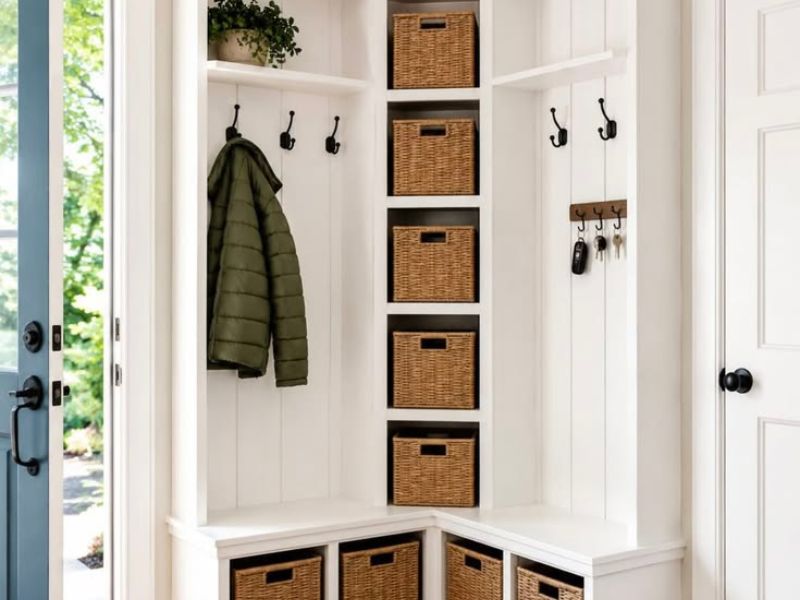
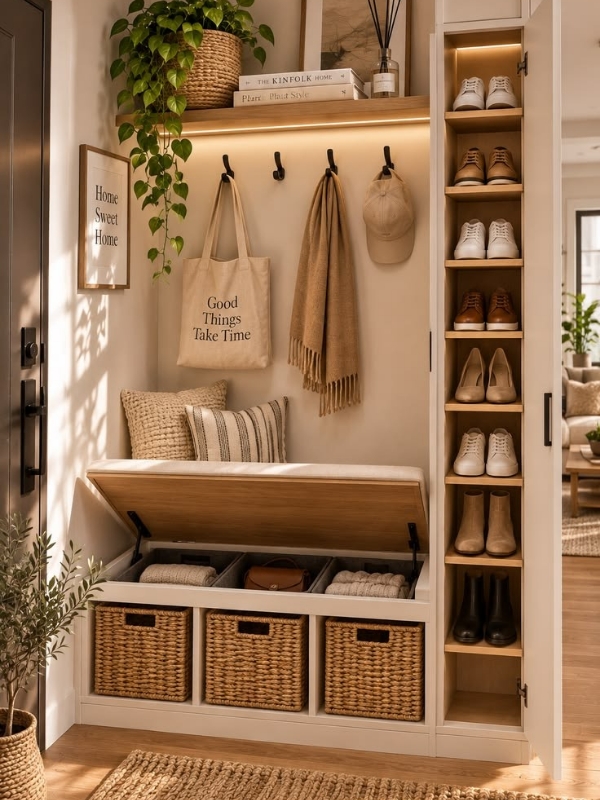
Start by using the space you already have. Add wall hooks for bags and jackets, a slim shoe cabinet for footwear, or a small basket for keys and other everyday essentials. If you have unused wall space, install floating shelves to keep items off the floor. A narrow bench with storage underneath can also give you a place to sit while hiding shoes and accessories.
Adding personality to your living space becomes much easier with How to Transform Your Home With Colorful Living Room Ideas For An Inviting Space, featuring practical ways to brighten your home without overwhelming it.
Choose storage pieces that match your routine. Keep the items you use most often within easy reach, and move seasonal or rarely used belongings to higher shelves or closed storage. These simple choices can keep clutter under control while making a small entryway feel more open, organized, and welcoming.
Entryway Storage Ideas for Small Spaces to Keep Shoes, Bags and Everyday Clutter Organized
1. Start with a Wall-Mounted Coat Rack

A wall-mounted coat rack is one of the most effective entryway storage ideas for small spaces because it uses vertical wall space rather than floor space. Because it requires no footprint at all, even the narrowest entryway can accommodate one.
Choosing the right coat rack
Look for a rack with a combination of large hooks and smaller hooks at different heights. Also, a shelf above the hooks doubles the storage capacity without adding more wall length. When the shelf holds keys, sunglasses, and a small plant, the rack becomes a complete entryway station.
Because households have different needs, consider who uses the entryway most. When children are involved, lower hooks at their height mean they can hang their own bags and coats without help. So the rack teaches habits as well as managing clutter.
Material and style choices
Wooden coat racks with brass hooks suit warm, traditional interiors. Also, metal and black matte finishes suit modern and Scandi aesthetics. When the rack matches the existing hardware in the space, it looks considered rather than added as an afterthought.
After installing the rack, commit to using it consistently. Because a coat rack only works when coats actually land on the hooks rather than on a nearby chair, the installation is just the beginning.
QUICK TIP: Install the rack at a height where the longest coat you own will not drag the floor. Because the coat length varies by household, measure before drilling.
Looking for a way to set up your desk for educational purposes? Check out this ideas that will help you start up your dorm desk Dorm Desk Setup: How to Organize a Small Study Space Without the Clutter
2. Add a Narrow Entryway Bench with Under-Seat Storage
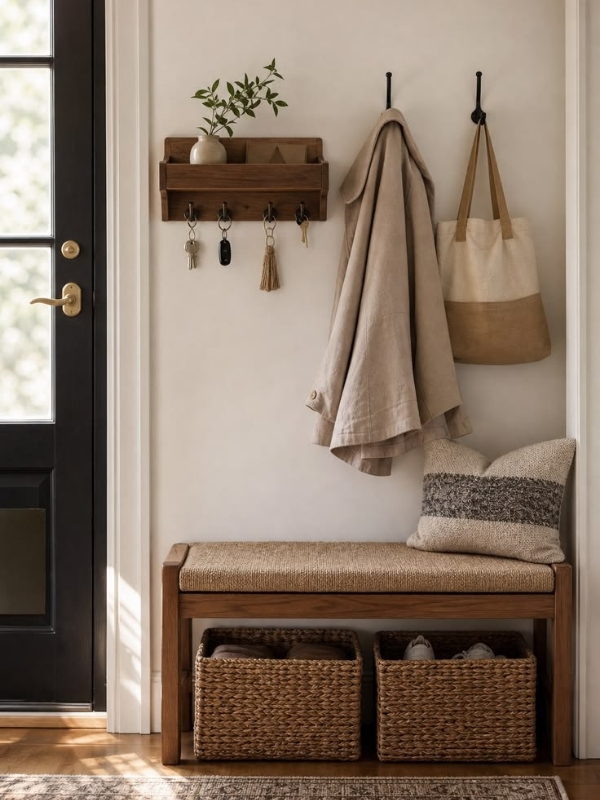
When floor space allows even a small bench, it transforms the entryway experience. Because a bench gives you a place to sit while putting on shoes, the whole process becomes less rushed. Also, when the bench has storage underneath, it solves the shoe problem at the same time.
Storage bench options
A lift-up storage bench holds several pairs of shoes inside the seat. Also, an open-bottom bench with baskets underneath organizes shoes visibly and makes grabbing the right pair fast. Because both approaches work, choose based on whether you prefer hidden or accessible shoe storage.
When the bench is too deep for the space, a narrow floating bench mounted to the wall creates the sitting surface without taking floor space below it. So baskets can be added below or the floor beneath stays completely clear.
Lighting has the power to completely change a room, and Modern Home Lighting Inspiration showcases beautiful lighting ideas that enhance both the style and atmosphere of your home.
Styling the bench
A bench cushion in a durable fabric adds comfort and colour. When a small cushion matches other textiles in the home, the entryway feels cohesive with the rest of the house. Also, a basket on top of the bench holds gloves, scarves, and everyday essentials within reach.
Because benches can quickly become landing pads for everything, establish a rule about what belongs on them. After setting that boundary, the bench stays functional rather than becoming another surface to clear.
QUICK TIP: Choose a bench with legs rather than a solid base. Because legs create visual space under the bench, the entryway reads as more open even when the bench is full.
For kitchen storage ideas that make small homes function better, our post on Small Kitchen Storage Ideas for Small Spaces to Maximize Every Inch of Your Kitchen is full of organizational and decor inspiration that translates directly into modern styling.
3. Use Floating Shelves Above the Door

Entryway storage ideas for small spaces almost always overlook the space directly above the door frame. Because this area is several feet wide and completely unused in most entryways, it offers storage without competing with any other element in the space.
What to store above the door
This area is best used for items accessed infrequently: extra umbrella, seasonal bags, a spare set of guest towels, or holiday decorations stored in a labelled basket. Also, when attractive storage boxes are used, the above-door shelf looks intentional from below.
Because reaching above a door frame requires a step stool, this is not the right spot for daily-use items. When only occasional-use items go up there, the inconvenience of the height becomes irrelevant.
Installing the shelves
A simple floating shelf installed with invisible wall anchors looks clean and intentional above a doorframe. Also, a wooden board cut to width and painted to match the wall disappears visually while providing genuine storage capacity.
For more ideas on styling shelves and storage displays in a way that looks beautiful, our post on Bedroom Decor Ideas You Can Actually Make, Not Just Shop For a Cozy, Personal Space gives you room-by-room display inspiration that translates directly into kitchen shelf styling.
When the shelf is the same colour as the wall, the eye does not register it as a storage solution from the room below. Because it reads as architectural detail rather than furniture, it makes the entryway feel curated.
QUICK TIP: Depth matters above a door. Because a shelf that is too deep looks awkward and catches the eye for the wrong reason, keep it between fifteen and twenty centimetres deep.
Learn how to Decorate your home with this small space decorating ideas for your home.
4. Install a Vertical Shoe Rack or Shoe Cabinet

Shoes are the biggest source of entryway clutter in most homes. So addressing shoe storage is one of the highest-impact entryway storage ideas for small spaces available. Because shoes take up more floor space than any other entryway item, containing them properly transforms the whole space.
Vertical shoe storage options
A slim, tall shoe cabinet with a flip-down front stores eight to twelve pairs of shoes in a footprint the size of a single shoe. Also, a vertical wall-mounted shoe rack with angled brackets organizes up to twenty pairs without any floor space at all. Because vertical storage scales upward rather than outward, it suits narrow hallways particularly well.
When children are involved, add a lower row of hooks or a small basket for their shoes. Because children’s shoes are small, a single basket often holds a full week’s worth of pairs without organization.
The seasonal rotation principle
Store only the current season’s shoes in the entryway. Also, move off-season shoes to a bedroom wardrobe or under-bed storage to free up entryway capacity. When only the shoes you are actually wearing this month are accessible at the door, the system is always manageable.
Because boots take up significantly more space than flat shoes, having a specific spot for them prevents the rest of the system from being disrupted. So designate a boot space from the start.
QUICK TIP: Label each shoe space in a family home with the owner’s name. When everyone knows exactly where their shoes go, the system maintains itself without constant reminders.
When seasonal decor meets storage, the kitchen looks beautiful through every time of year. Our post on DIY Fall Wreath Craft for a Bare Front Door: Easy Budget-Friendly Autumn Decor That Looks Expensive shows how handmade seasonal pieces can work alongside a well-organized kitchen aesthetic.
5. Add a Row of Wall Hooks at Different Heights

Wall hooks are among the simplest and most effective entryway storage ideas for small spaces. Because they require no cabinetry, no floor space, and minimal installation, they are the right starting point for almost any entryway regardless of its size.
Hook height and arrangement
Mount a row of hooks at adult coat height and a second row at child height directly below it. Also, a third set of small hooks at adult hip height holds bags, umbrellas, and tote bags. When hooks are at the right height for what they hold, the system is used correctly without anyone thinking about it.
Because hooks spaced too close together create a jumbled pile of coats, space them at least twenty-five centimetres apart. When each hook has room for one coat to hang properly, the entryway looks organized even when all hooks are full.
Small pots and containers are among the most versatile kitchen storage and decor pieces available. Our post on Mini Terra Cotta Pots Crafts: Easy and Adorable Pot Decorating Ideas shows how to turn simple containers into beautiful kitchen storage and herb display pieces.
Decorative versus functional hooks
Decorative hooks in interesting shapes work just as well as plain ones. Also, when hooks are chosen deliberately, they become part of the entryway decor. In fact, a well-chosen hook set can be the single decorative statement in an otherwise minimal entryway.
However, choose hooks rated for the weight they will carry. Because a coat hook that pulls from the wall under the weight of a winter coat creates more problems than it solves, checking the weight rating before buying is non-negotiable.
QUICK TIP: Adhesive hooks rated for heavy loads work on tiles and painted walls without drilling. When you rent your home, command hooks let you create a proper hook system without damaging the walls.
6. Use a Mirror with Hidden or Integrated Storage

A mirror in the entryway serves two purposes at once. Because it reflects light and creates the visual impression of more space, it is one of the most powerful entryway storage ideas for small spaces available. When it also incorporates storage, it becomes a complete entryway solution in a single piece.
Types of storage mirrors
A full-length mirror with hooks attached to the frame holds bags and keys while providing a getting-dressed-before-leaving check. Also, a cabinet-style mirror with shelves or a corkboard behind the door holds mail, keys, and small accessories invisibly when closed. When closed, it looks like a simple decorative mirror. When open, it reveals a complete organizational system.
Because a leaning floor mirror requires no installation, it suits rental spaces or anyone hesitant about drilling. When leaned in a corner beside the door, it uses no wall space and reflects light into the hallway.
Placement for maximum effect
Position the mirror opposite the main light source in the entryway. Also, when a mirror reflects a window or a light source, the hallway gains a perception of depth that is disproportionate to its actual size. So the same small space looks significantly more generous.
Bold interiors can still feel warm and welcoming, and Dark Home Decor Ideas explores stylish ways to decorate with deeper colors while keeping your space balanced and inviting.
After choosing the placement, keep the mirror clean regularly. Because a smudged or dirty mirror does the opposite of what a clean one achieves, maintaining it is part of the storage strategy.
QUICK TIP: A narrow, tall mirror suits a hallway better than a wide, short one. When the mirror emphasizes height rather than width, the entryway feels taller and more welcoming.
7. Repurpose a Cabinet as a Hallway Closet
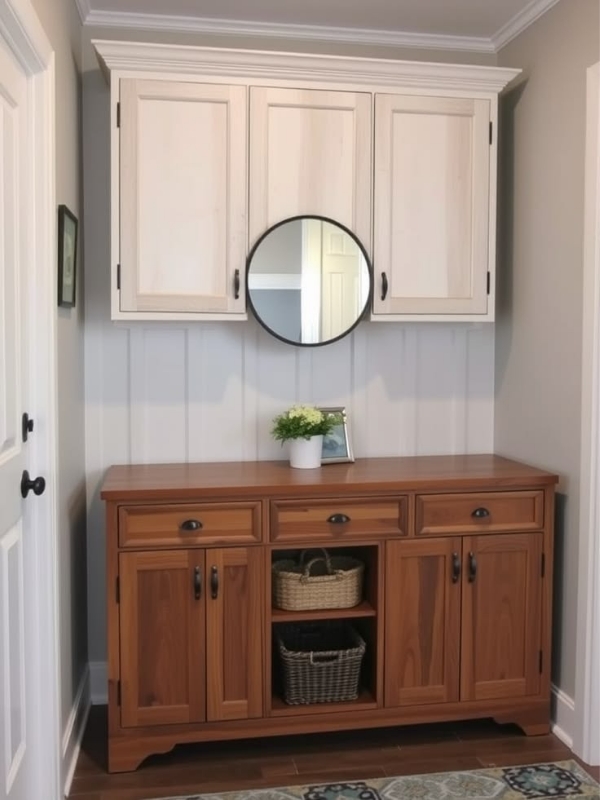
When a dedicated closet is not available, a freestanding cabinet does the same job. Because a tall cabinet with doors conceals everything inside, it creates the visual effect of a closed closet without any building work. Also, this is one of the most flexible entryway storage ideas for small spaces because the cabinet can be moved if needed.
What to look for in a hall cabinet
A cabinet with a mix of hanging space, fixed shelves, and a base area covers every entryway storage need. Also, double-door cabinets are more accessible than single-door ones because they open wide and reveal the full contents at once. Because narrow depth is important in a small hallway, look for cabinets that are thirty to forty centimetres deep rather than the standard sixty.
When a cabinet is too large for the space, it creates the crowding it was meant to solve. So measure the hallway width and the cabinet depth before purchasing.
For handmade Christmas entryway decor that looks genuinely beautiful, our post on Christmas Crochet Projects You Can Actually Finish Before the Holidays for Gifts, Decor, and More is a full collection of festive handmade entryway and home decor ideas.
Organizing inside the cabinet
Use the hanging rod for coats and long bags. Also, add a shelf above for hats, scarves, and small bags. When a boot tray is placed at the base, muddy shoes go directly inside the cabinet rather than on the hallway floor.
After organizing the cabinet, commit to closing the doors consistently. Because the visual benefit of a closed cabinet is its main advantage over open storage, leaving the doors open defeats the purpose.
QUICK TIP: Add an adhesive mirror to the inside of the cabinet door. When the mirror is inside, the cabinet becomes a dressing station as well as a storage unit.
8. Make an Over-the-Door Organizer Work Harder

An over-the-door organizer is one of the quickest and most affordable entryway storage ideas for small spaces. Because it uses the back of an existing door, it requires no drilling and no additional floor or wall space. Also, it is removable, which makes it ideal for renters.
What to use it for
The back of the front door holds an over-door organizer filled with gloves, sunscreen, dog leads, small first aid items, and the other daily-use objects that tend to float around an entryway without a home. Also, shoe-pocket organizers on the back of a coat cupboard door hold flat shoes, sandals, and slippers cleanly.
When an over-door hook rack is used instead of a fabric organizer, coats, bags, and umbrellas hang neatly on the back of the door. Because the door is normally closed, the hooks are hidden during everyday use.
Choosing the right product
Check the door gap before buying. Because over-door organizers require enough clearance between the top of the door and the door frame, a product that is too thick prevents the door from closing properly. Also, ensure the weight rating suits what you plan to hang.
QUICK TIP: Use the organizer pockets to create a family system: one pocket per person in the household for small daily essentials.
For more summer creative ideas on turning everyday materials into functional and beautiful home objects, our post on Summer Home Decor Ideas to Refresh Every Room covers a wide range of decor projects that include practical home storage and organization ideas.
9. Use a Pegboard for Fully Customizable Entryway Storage

A pegboard is one of the most adaptable entryway storage ideas for small spaces because it is completely customizable. When hooks, baskets, and small shelves attach anywhere on the grid, the storage configuration changes as needs change. Because nothing is fixed, the system grows with the household.
Check out this Small Bathroom Makeover
Setting up a pegboard
Mount the pegboard on the wall at the most convenient height for the household. Also, paint it the same colour as the wall for a seamless look, or choose a contrasting colour to make it a design feature. When the pegboard is painted, it looks designed rather than improvised.
Start with hooks for bags and coats. After those are in place, add small baskets for keys, sunscreen, and dog leads. Because the baskets hook directly onto the grid, adding and moving storage takes seconds.
Making it look intentional
Keep the pegboard items consistent in material and colour. Also, leave some empty grid space rather than filling every inch. When a pegboard is overcrowded, it looks chaotic rather than organized. So curate what lives on it with the same care as any visible storage.
After setting up the pegboard, review it quarterly and adjust the layout to suit changing needs. Because the whole system can be reconfigured in twenty minutes, it is worth doing when the seasons change.
QUICK TIP: Paint the pegboard accessories, hooks, and baskets in the same finish. When everything matches, the pegboard looks like a designed feature rather than a collection of mismatched hardware.
For beautiful and budget-friendly autumn entryway decor ideas, our post on Dollar Tree Fall Crafts That Look Expensive (Easy DIY Decor Anyone Can Make) is full of seasonal entryway decoration ideas that cost almost nothing.
10. Contain Shoes in Baskets and Labelled Bins

When a shoe cabinet is not possible, baskets and labelled bins are one of the most practical entryway storage ideas for small spaces. Because they are flexible, inexpensive, and visually pleasant, they suit a wide range of entryway styles and household sizes.
How to set up a bin system
Assign one basket or bin per family member. Also, add a label to each bin with the owner’s name so there is never any confusion about where shoes belong. When each person is responsible for their own bin, the entryway maintenance does not fall to a single person.
Because deep baskets hide the mess inside while keeping the space looking tidy, choose those with high sides. When shoes are dropped in rather than arranged, the basket still looks organized from the outside.
For more ideas on sustainable household organization systems, our post on DIY Walkways Paths Cheap: How to Build a Garden Path on a Budget shows the same budget-conscious, practical approach to home improvement that applies to entryway organization.
Material and style options
Wicker baskets add warmth and work well in natural, farmhouse, and Scandi interiors. Also, cotton rope baskets suit a more modern or bohemian aesthetic. When bins are chosen in a consistent material, the entryway looks cohesive even when the shoes inside are varied and personal.
After the system is in place, do a quick reset every week by returning anything that has migrated out of the bins. Because baskets make the reset fast, the system is low maintenance once established.
11. Add a Small Console Table for Keys and Mail

A console table in the entryway provides a landing surface for daily items and creates a visual anchor for the space. Because narrow console tables start at twenty-five centimetres deep, even very small hallways can accommodate one. Also, entryway storage ideas for small spaces that include a surface for mail, keys, and daily essentials reduce the likelihood of those items ending up on a kitchen counter or sofa.
For beautiful handmade pot ideas that make entryway plants look genuinely designed, our post on DIY Gardening Ideas for Small Spaces and Tiny Backyards is full of compact growing and planting ideas that work in entryway spaces.
What to keep on the console table
A small tray on top of the table corrals keys, coins, receipts, and other pocket contents. Also, a hook below the tabletop edge holds bags and prevents them from being placed on the floor. When a small plant sits on one end of the table, it adds life to the space without interfering with function.
Because the console table surface is visible the moment anyone enters the home, keeping it clean is particularly important. When the table looks cluttered, the entire entryway feels cluttered. So the one-tray rule, everything goes in the tray rather than directly on the table, keeps it manageable.
Choosing the right table
In very narrow hallways, a wall-mounted floating console eliminates legs entirely and reads as more visually lightweight. Also, a floating console mounted at the right height doubles as a bench for putting on shoes. When it is positioned at a practical height, the furniture works for two purposes simultaneously.
QUICK TIP: Store daily items in the tray in the same position every day. Because consistency in placement means you never search for keys, the tray becomes a system rather than just a surface.
12. Create a Mini Mudroom in Any Space

A mudroom does not require a dedicated room. Because the concept, not the room, is what matters, you can create a fully functional mini mudroom in a hallway corner, a recessed alcove, or even a short stretch of wall. When these entryway storage ideas for small spaces are applied together, the effect is exactly the same as a built-in mudroom.
For creative Halloween entryway decor ideas, our post on Halloween Crafts for Teens: 15 Projects for Room Decor, Costumes, and Fun has handmade seasonal door and entryway decoration ideas for the whole family.
The essential mudroom elements
A mudroom requires four things: hooks for coats, a seat for putting on shoes, shoe storage beneath the seat, and a boot tray on the floor. Also, a small shelf above the hooks holds hats, helmets, and bags. When all four elements are in place, the corner looks designed rather than improvised.
Because each element can be purchased separately and positioned together, there is no need to buy a specific mudroom system. After setting up the four elements, the space functions as a mudroom regardless of its size.
Making it work for the household
When there are children in the home, add labelled hooks at child height and a separate basket for their shoes. Also, when pets are in the household, a hook for leads and a small shelf for treats and waste bags make the pet corner part of the mudroom.
After setting up the mudroom corner, create a consistent routine around it. Because habits make storage systems sustainable, the routine is as important as the furniture.
QUICK TIP: Keep a small umbrella stand in the mudroom corner. When wet umbrellas have a specific spot to dry, they stop dripping across the hallway floor.
13. Use a Rotating Storage Tower for Corner Spaces

Corner spaces in the entryway are consistently underused. Because a rotating storage tower fits into a corner and turns to face whichever direction is needed, it transforms dead corner space into active storage. Also, this is one of the entryway storage ideas for small spaces that requires the smallest wall footprint of any storage furniture.
What a rotating tower can hold
Rotating towers work well for umbrellas, small bags, scarves, and lightweight items. Also, a tower with shelves at different heights holds both folded items and hanging ones simultaneously. When the tower turns, every item is accessible without moving anything else.
For handmade Christmas entryway decor that looks genuinely beautiful, our post on Christmas Crochet Projects You Can Actually Finish Before the Holidays for Gifts, Decor, and More is a full collection of festive handmade entryway and home decor ideas.
Because rotating towers are freestanding, they suit rental properties perfectly. When the storage need changes, the tower moves to a different corner or a different room. So the investment is flexible rather than permanent.
Styling the rotating tower
Choose a tower in a material that complements the entryway palette. Also, when the tower is used consistently and holds only what it is designed to hold, it looks intentional from every angle. Because it rotates, the view from any position in the entryway includes the tower, so all sides matter equally.
After setting it up, assign a category to each section of the tower rather than mixing items across the shelves. When like items are grouped, finding what you need is fast and intuitive.
QUICK TIP: A small towel or cloth on one shelf of the rotating tower serves as a place to wipe wet umbrellas or muddy hands at the door.
14. Bring Plants into the Entryway

A plant in the entryway does something practical as well as decorative. Because plants signal life and calm at the threshold of the home, the emotional effect of entering a space with greenery is genuinely different from entering one without it. Also, when plants are placed strategically in an entryway, they contribute to the spatial composition of entryway storage ideas for small spaces rather than competing with it.
Choosing the right plants for an entryway
Because entryways are often low-light spaces, choose plants that tolerate shade: pothos, snake plants, ZZ plants, or cast iron plants. Also, when the entryway receives some natural light, a trailing plant on a high shelf adds movement and visual interest without occupying valuable lower space.
When the entryway has genuinely very little light, choose a high-quality artificial plant rather than a struggling real one. Because a thriving artificial plant looks better than a dying real one, the choice is practical rather than a compromise.
For stunning July 4th front door and entryway wreath ideas, our post on 4th of July Wreath Ideas to Make Your Front Door the One Everyone Stops to Admire is packed with patriotic entryway decoration ideas for the summer season.
Integrating plants with storage
Place a plant at the end of the console table. Also, a hanging plant above the coat rack fills vertical space while adding softness to what is otherwise a functional element. When plants are integrated with storage pieces rather than placed separately, they feel part of the design rather than additions.
Because entryway plants are seen every day, they are worth choosing with as much care as any other element in the space.
QUICK TIP: Use a simple terracotta pot for an entryway plant. Because terracotta suits almost every interior style, it is the safest single-choice planter for an entryway.
15. Label Everything and Build a Maintenance Routine

The most overlooked of all entryway storage ideas for small spaces is the labeling and maintenance step. Because even the best storage system breaks down without ongoing management, building a simple routine is as important as any furniture purchase.
Creating a labeling system
Label each hook, shelf, basket, and bin with its designated use. Also, when the label is specific rather than vague, anyone in the household knows exactly where things belong without being told. Because a clear system runs without individual reminders, it reduces household friction considerably.
When labels are consistent in style and placement, they become part of the decor rather than visual noise. So spend a little time making them look intentional rather than rushed.
For budget-friendly Christmas entryway decor using dollar store materials, our post on 12 Christmas Dollar Tree Crafts You’ll Be Proud to Display in Your Living Room shows affordable seasonal entryway decoration ideas.
The weekly reset
Set aside five minutes weekly to return misplaced items to their correct spot. Also, when the weekly reset is part of an existing routine, such as the beginning of the weekend or Monday morning, it happens consistently rather than when the situation becomes critical.
Because entryways accumulate clutter faster than any other area of the home, a weekly five-minute reset is more effective than a monthly overhaul. When small resets happen regularly, the big overhaul never becomes necessary.
Reviewing the system seasonally
Every season brings different storage needs. Also, when the wardrobe changes, the entryway storage should change with it. So a seasonal review of what is accessible and what can be stored elsewhere keeps the system relevant year-round.
QUICK TIP: Photograph the entryway after each reset. Because the photograph shows the standard you are maintaining, it makes the next reset faster and clearer.
Make Every Inch of Your Entryway Count
Small entryways need smart solutions that work without overwhelming the space. Look beyond the floor and use your walls, doors, and corners to create extra storage. A row of hooks can hold coats, hats, and everyday bags, while a narrow shelf can give you room for keys, sunglasses, and small accessories.
You can also turn the area behind the door into useful storage. Add slim hooks or an over-the-door organizer for items that often create clutter. For shoes, choose a vertical rack or a slim cabinet that fits close to the wall. If your entryway has an awkward corner, place a small basket there for scarves, umbrellas, or reusable shopping bags.
Keep the setup simple and give each item a specific spot. This approach makes daily tidying easier and helps your small entryway stay organized without taking up valuable floor space.
Frequently Asked Questions
1. What are the best entryway storage ideas for small spaces in a rented home?
Entryway storage ideas for small spaces in rented homes work best when they require no permanent installation. Because adhesive hooks, over-door organizers, freestanding shoe racks, and rotating towers use no drilling, they suit rented properties perfectly. Also, tension rods and command strip products hold surprising amounts of weight on tiles and painted surfaces. When the tenancy ends, these solutions remove cleanly without damage. So renting does not prevent you from having an excellent entryway system.
2. How do I stop the entryway getting cluttered again after organizing it?
The most effective way to maintain entryway storage ideas for small spaces is to build a five-minute weekly reset into your existing routine. Also, because the entryway is the most-used transition space in the home, items naturally drift out of place faster than in other rooms. When the reset is brief and consistent, the system never reaches the point of full breakdown. So the key is frequency, not duration. Five minutes weekly beats thirty minutes monthly.
3. What should I prioritize when setting up a small entryway from scratch?
When setting up entryway storage ideas for small spaces from scratch, start with the items that create the most clutter. Because shoes and coats are the biggest contributors to entryway disorder, address those two categories first. Also, once shoes and coats have a designated home, everything else becomes easier to organize. So a shoe solution and a coat hook row are the minimum viable entryway system. After those are in place, add what the specific household needs next.
4. How do I make a small entryway look bigger?
A mirror is the single most powerful tool for making a small entryway look larger. Also, when wall hooks and vertical storage replace floor-standing furniture, the floor space reads as more generous. Because light colours on walls make a space feel more open than dark ones, a light-toned entryway always reads as larger than its actual measurements. When these three elements are combined, a very small entryway becomes genuinely welcoming.
5. What is the most common mistake in small entryway organization?
The most common mistake in entryway storage ideas for small spaces is buying storage products before removing what is not needed. Because new organizers placed around existing clutter just create organized clutter, the clear-out must come first. Also, buying storage that is too large for the space creates the crowding it was meant to solve. So measuring the space and editing the contents are the two steps that must happen before any purchase is made.
Your Entryway Is Already Telling a Story
The entryway creates the first impression when you walk through the door. A calm, organized space can make coming home feel easier and more welcoming. That small shift shows why the right entryway storage ideas for small spaces can make such a difference in your daily routine.
Start with one simple change instead of tackling everything at once. Hang a few sturdy hooks for coats and bags, then add shoe baskets or a slim rack near the door. Once those pieces work well, you can add a small shelf, tray, or basket for keys and other everyday items. Each improvement can make the next step feel easier.
The fifteen entryway storage ideas for small spaces in this guide give you plenty of ways to create a setup that fits your hallway and your household. Choose two or three ideas that solve your biggest clutter problems, try them first, and build from there as your needs change.