
Struggling to find crafts that fit changing mobility? These hand crafts for seniors with limited mobility offer practical ideas you’ll want to try.
Getting older can change the way you move, but it doesn’t necessarily change your desire to make something with your own hands.
As you grow older and your strength or mobility changes, you may still want to create something for your home, make a gift for someone you love, or simply spend an afternoon doing something that feels satisfying.
Limited mobility can change how you approach an activity, but it doesn’t have to take creativity out of your day.
The key is finding projects that respect your comfort, leave room for your own choices, and don’t make you feel as though you’re being handed an activity simply because you’re older.
That is what makes hand crafts for seniors with limited mobility worth choosing carefully.
The right project should give you something you genuinely enjoy making and, ideally, something you will want to keep, use, display, or give away when you’re done.
When familiar activities start feeling repetitive, Crafts for Seniors in Assisted Living When the Days Feel Long and the Usual Activities Get Old offers fresh ideas that can make craft time feel more meaningful.
Limited Mobility Is Not the Same as Limited Hand Ability

Limited mobility can affect walking, standing, balance, or how easily someone changes position without affecting their ability to use their hands.
Someone may need a wheelchair or spend most of the day seated and still have good control of their fingers and hands.
Others may also have arthritis, weakness, tremors, or reduced dexterity. That difference matters when choosing a craft, because the right project should match the person’s actual abilities rather than assume that every senior has the same limitations.
Before Choosing the Craft, Look at What Your Hands and Body Have to Do

Think through the movements the project will involve from beginning to end. Will you need to grip a tool tightly, pinch small pieces, reach forward repeatedly, hold something steady, or make the same hand movement many times?
Some movements may feel perfectly manageable, while others may leave your hands tired or uncomfortable.
Limited mobility can also affect how long you can sit in one position, how far you can reach, or how easily you can move materials around you. Arthritis, weak grip, tremors, or reduced finger movement can add another layer to consider.
That doesn’t mean you have to give up on a project you like. You can use larger materials, choose easier-to-hold tools, bring everything within comfortable reach, or work on one small part at a time.
The goal is to make the physical side of crafting easier without taking away your choices or your enjoyment of making it.
Hand Crafts for Seniors With Limited Mobility That Actually Have a Purpose
1. Large-Scale Weaving on a Cardboard Loom

A small cardboard loom can turn weaving into a much more manageable project without making it feel childish or overly simplified.
Instead of working with a large floor or table loom, you create a compact frame from sturdy cardboard and weave thick yarn, ribbon, or narrow strips of fabric through the warp threads.
The finished piece can become a small wall hanging, table mat, decorative textile panel, or even part of a larger home project.
The important part is scale. Use a loom with fewer, wider-spaced warp threads rather than packing dozens of fine threads into a tiny frame. Choose chunky, smooth yarn or wider fabric strips that are easier to see and handle.
A cardboard loom can also sit flat on a table, which makes it easier to keep the work within a comfortable reach.
That doesn’t mean every senior with limited mobility will find weaving comfortable. The over-and-under movement still involves repeated hand and arm movements, so the project should match the person’s actual hand control, reach, endurance, and comfort.
Make the loom easier to manage
The person making the craft does not necessarily need to prepare every part of the loom.
A helper can cut the cardboard, make the notches, secure the warp threads, and place the loom on a non-slip surface.
The senior can then take over the parts that involve the creative decisions: choosing colours, deciding the order of the yarn, changing textures, and deciding when the piece feels finished.
That distinction matters. Assistance with the physical preparation doesn’t have to mean taking over the craft.
For someone who struggles with gripping small objects, thicker yarn can make more sense than embroidery thread. Larger handles and built-up grips can also reduce the amount of tight gripping required when tools are necessary.
Occupational-therapy guidance commonly recommends adapting equipment, reducing unnecessary force, and taking regular breaks when hand conditions make hobbies difficult.
Keep the design open-ended
This is where the project becomes more interesting than a basic “weave yarn over and under” activity.
Give the senior several materials to choose from:
- chunky wool or acrylic yarn
- strips of cotton fabric
- ribbon
- soft cord
- textured yarn
- different-width yarns for contrast
The finished weave does not have to follow a strict pattern. One person might prefer orderly stripes, while another might enjoy mixing textures and colours until the surface looks more like a piece of abstract textile art.
And there is no need to finish the entire loom in one sitting. A small section can become the day’s project, with the weaving continued another day when the person has more energy.
The goal is not to make the loom as small as possible. It is to make the project manageable without stripping away the choices that make crafting satisfying.
Adults looking for something different to do at home can browse Creative DIY Crafts for Adults: 20 Fun Crafts for Adults to Try When You’re Bored at Home.
2. Large-Piece Paper Quilling

Traditional quilling can involve very narrow paper strips and tiny coils, which may not suit someone who struggles with fine finger movements. A better approach for hand crafts for seniors with limited mobility is to scale the project up.
Use wider paper strips and make larger coils, loops, spirals, and scrolls. These can become a simple floral design, an initial, a geometric pattern, or an abstract piece of wall art.
The senior can choose the colours and decide how the shapes fit together, while someone else can handle tasks such as cutting the strips or preparing the backing paper when needed.
A few adjustments can make a noticeable difference:
- Choose wider strips instead of narrow quilling paper.
- Make larger shapes that are easier to position.
- Work on a flat, non-slip surface so the paper does not keep shifting.
- Keep the design simple enough to pause and resume without losing your place.
- Use a small number of prepared shapes rather than expecting the entire piece to be completed at once.
This craft still involves repetitive finger movements, so it is not automatically suitable for someone with significant hand pain or very limited dexterity. The point of scaling it up is to reduce unnecessary precision, not to pretend that quilling requires no hand control.
The finished piece can be mounted as wall art, used as a decorative panel, or framed once complete. That gives the project a proper end result rather than making it feel like an activity that was chosen simply to keep someone occupied.
3. Foam-Block Printing
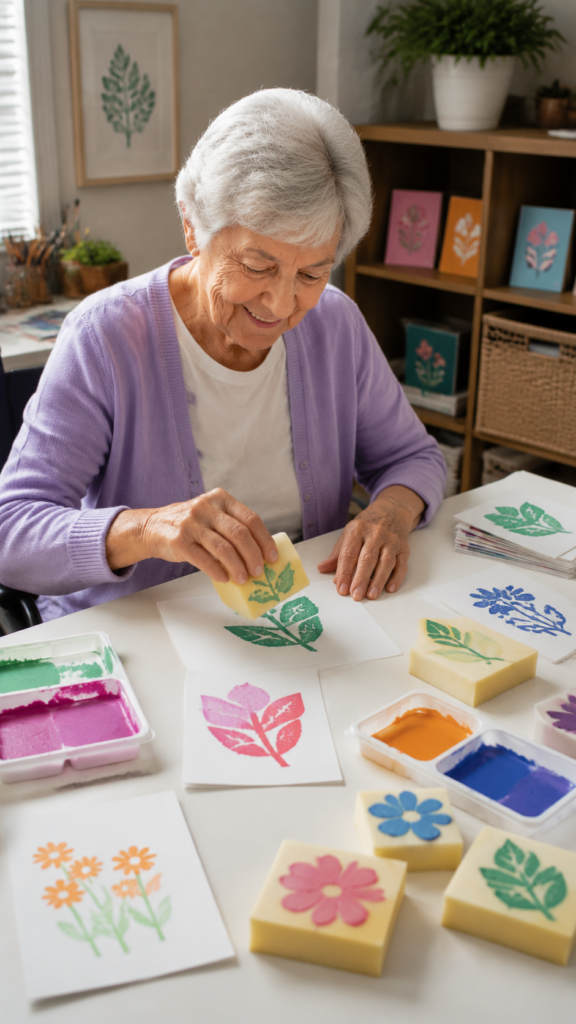
Foam-block printing can work well for hand crafts for seniors with limited mobility because the design process can stay simple while still giving you plenty of room to make creative choices.
You can press or draw a design into a piece of craft foam, apply paint or ink to the raised surface, and transfer the pattern onto paper, cards, fabric, or another suitable surface.
Keep the foam block large enough to hold comfortably, and choose a handle or backing that doesn’t require a tight grip. You can also prepare the printing surface and paint in advance so you can concentrate on choosing colours, positioning the block, and building the pattern.
The finished prints can become greeting cards, artwork, gift wrap, or decorative paper. You don’t need to create a complicated image either; repeating one shape in different colours can produce an interesting design without requiring detailed hand movements.
4. Layered Paper Relief Art

Layered paper relief art gives you a way to turn a simple collection of shapes into something personal.
You can build a scene from a favourite place, arrange flowers you love, recreate the colours of a room, or make an abstract piece simply because you enjoy the way the layers look.
The physical side can be adjusted without taking away the creative work. Larger paper shapes are easier to handle, and you can arrange them on a flat surface before fixing them in place.
Someone helping you can prepare or cut some of the pieces when necessary, while you decide the colours, placement, depth, and final arrangement.
That choice is what gives the project its value. You’re not simply assembling pieces of paper; you’re deciding what you want the finished picture to say or represent.
Once complete, it can become something you display at home, keep as a personal piece of artwork, or make for someone who would recognise the meaning behind it.
5. Felt Appliqué Without Fine Embroidery

Felt appliqué lets you create a fabric picture without relying on the small, repeated stitches that can become difficult when your hands are stiff, weak, or easily tired.
You can arrange larger felt shapes into flowers, animals, initials, landscapes, or patterns and attach them to a fabric or felt backing.
The project leaves plenty of room for personal choice. You might choose colours that remind you of a favourite season, create something based on a place you love, or make a design using the colours and initials of someone in your family.
A helper can cut the shapes or handle the adhesive when needed, while you remain involved in deciding what belongs where.
That makes the finished piece more than a decorative exercise. It can hold a memory, represent someone you care about, or simply reflect your own taste.
You can keep it as a small piece of personal artwork or turn it into something such as a wall hanging or decorative panel that has a place in your home.
Halloween craft time can be more than decorations with Halloween Crafts for Teens: 15 Projects for Room Decor, Costumes, and Fun.
6. Air-Dry Clay Texture Tiles

Working with texture gives you something to explore with your hands without requiring a complicated form.
Press a leaf, piece of lace, fabric, shell, or textured tool into a manageable piece of air-dry clay and see how the impression changes the surface.
For hand crafts for seniors with limited mobility, this project can stay small and work on a stable surface. You can choose textures that are easy to hold and press, while someone assisting you can help with cutting or moving the clay when needed.
There is no need to rush through several pieces at once; one carefully made tile can be enough.
The finished tile can carry more meaning when you choose a texture connected to something familiar.
A leaf from a favourite plant, a pattern you have always liked, or an object with a special memory can turn a simple clay impression into a small keepsake.
You can display it on its own, add a date or name, or make several pieces into a small wall arrangement.
7. Quilt-as-You-Go Mug Mat or Small Textile Panel
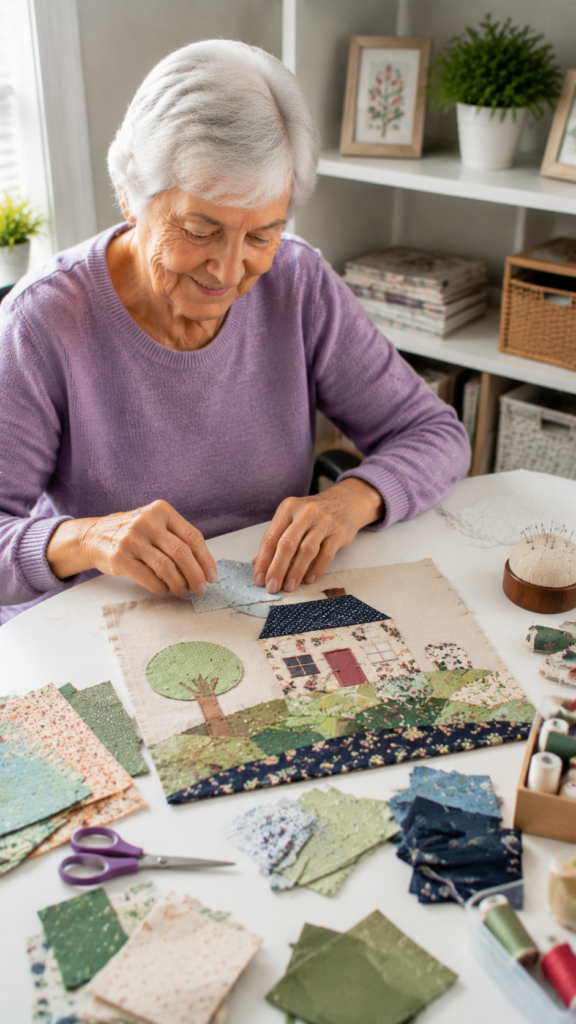
You don’t need to take on a full quilt to enjoy choosing fabrics and building a patchwork design. A mug mat or small textile panel lets you work with a much smaller surface, adding one section at a time until the piece is complete.
That smaller scale can make hand crafts for seniors with limited mobility easier to manage, particularly when reaching, handling large amounts of fabric, or working for long periods becomes tiring.
Choose larger fabric pieces and uncomplicated shapes, and get help with cutting or other precise tasks when necessary without giving up control over the colour combinations or arrangement.
The finished piece also has somewhere to go. A mug mat can become part of your everyday routine beside a favourite chair, while a small textile panel can bring colour to a wall or shelf.
Using fabric from a favourite garment, meaningful colour scheme, or family textile can make the project feel connected to your life rather than like something made simply to fill an afternoon.
8. Painting With an Adjustable Desk Easel

Painting can remain enjoyable when you don’t have to hold the canvas or keep leaning forward to work on it. An adjustable desk easel can keep the artwork at a comfortable angle and bring the working area closer to you.
Choose a lightweight board or canvas that fits securely on the easel, then experiment with the height and angle before you begin.
Larger brushes can be easier to hold than very thin ones, and working with a small selection of colours can keep the materials within easy reach without limiting the design.
You can paint something familiar, a favourite flower, a landscape from memory, a colourful abstract piece, or even the view from your window.
The finished painting can become something personal to keep or display, giving the time spent making it a purpose beyond simply completing an activity.
For projects with a more youthful, creative feel, see Fun DIY Crafts for Teens: Creative and Trendy Projects That Actually Feel Cool to Make.
What a Helper Should Do — and What They Should Leave Alone

Good hand crafts for seniors with limited mobility should make room for assistance without handing over the whole creative process.
Someone assisting you may need to do the parts that require more strength, reach, precision, or repetitive movement, but that does not mean they should decide what your project becomes.
A helper can:
- prepare materials
- cut difficult shapes
- open containers
- stabilize a board or work surface
- move supplies within comfortable reach
- handle tasks that require greater strength or precision
You should retain, whenever possible:
- colour choices
- composition
- placement
- design decisions
- material choices
- what the finished piece becomes
That distinction matters. Physical assistance does not have to mean creative control.
You can accept help with the parts your hands or body find difficult while still choosing what you want to make, how you want it to look, and what it means to you.
NIA guidance on meaningful activities similarly recommends matching activities to a person’s abilities and interests, helping with the parts they need assistance with, and allowing them to participate at a level that works for them.
What to Do on a Low-Energy Crafting Day

Your energy and mobility may not feel the same every day.
You might comfortably paint, cut fabric, or work with clay one afternoon, then find that even reaching for your supplies feels tiring the next. You don’t have to choose between completing the whole project and giving it up completely.
Instead, decide how much of the craft feels manageable that day. Someone helping you can take on the physically demanding parts, but you can still choose how involved you want to be.
Full Project
On a day when you have enough energy, you can complete the whole project yourself. You might paint the entire canvas, put together your fabric collage, or make a few clay texture tiles.
There is no need to make the project smaller or ask someone else to take over unless you want the help.
Reduced Project
Make the same craft on a smaller scale. Use fewer colours, larger pieces, a simpler design, or fewer steps.
You might paint a simple flower instead of a detailed scene, create a fabric collage from a handful of larger pieces, or make one felt flower instead of a design with several small shapes. The idea stays yours; you are simply reducing the amount of physical work involved.
Shared Project
You can decide which parts you want to do and which parts someone else can handle.
Someone assisting you might cut fabric for your collage, prepare the clay, open containers, or move materials into a comfortable position. You can then choose the colours, arrange the pieces, create the texture, or complete whatever part you feel able to manage.
Creative-Only Participation
You don’t have to handle every material to remain part of the project. You can choose the colours, decide on the design, direct where pieces should go, or add a few finishing touches while someone else takes care of the more demanding work.
For example, you might decide how the layers should be arranged in a paper relief while someone else cuts the shapes. You could choose the fabrics for a small textile panel and decide the final arrangement without doing the cutting yourself.
Watch-and-Decide
There may also be days when you simply don’t feel like crafting with your hands. You can still take part by choosing what to make, deciding between colours or materials, giving directions, or watching the project come together.
Someone could arrange the pieces of a fabric collage while you decide which combination works best, or prepare a clay tile while you choose the texture you want to press into it.
Know that: A low-energy day doesn’t have to mean a no-craft day, and accepting physical help doesn’t mean giving up ownership of the project. You can decide what you want to make, how much you want to do, and when you’ve done enough for that day.
Bring some colour into a sunny afternoon with Cute Summer Crafts: Bright and Simple DIY Ideas for Sunny Days You’ll Want to Try
How to Tell Whether a Craft Is Actually Worth Making

A craft can look easy on paper and still be frustrating once you start.
When choosing hand crafts for seniors with limited mobility, it helps to ask whether the project gives you enough enjoyment, meaning, or usefulness to make the effort worthwhile.
Ask yourself:
- Will I actually enjoy making this? A project doesn’t have to be practical if you genuinely enjoy the colours, textures, or creative process.
- Can I adapt the difficult parts? You should be able to use larger pieces, easier-to-hold tools, or get help with preparation without losing control of the design.
- Will I care about the finished piece? You might want something to display, use around the house, give to someone, or keep because it reminds you of a person or place.
- Can I stop and continue later? Projects that allow you to work in short sessions are often easier to live with than ones that require hours of continuous work.
- Does the effort feel reasonable? A beautiful finished piece may not be worth it if getting there leaves your hands painful or your body exhausted.
For example, you might be choosing between a detailed embroidery project and a fabric collage.
If small, repeated stitches are difficult for your hands but you enjoy choosing colours and arranging fabric, the collage may be the better choice.
You can still create something personal without spending most of your energy on movements that are uncomfortable.
The best project isn’t necessarily the easiest one. It is the one that gives you a reason to keep making it without asking your body to do more than it comfortably can.
Conclusion
The best hand crafts for seniors with limited mobility are not necessarily the simplest ones.
They are the projects that let you create something you genuinely enjoy without making your body work harder than it needs to.
Choose a craft that can bend with your energy, accept a little help when needed, and still leave the important creative decisions in your hands.
Ready to make something? Pick one project from this list and adapt it to what feels comfortable for you today.
FAQs
1. What are the best crafts for seniors with limited mobility?
The best choices are crafts that can be done in a comfortable position, paused easily, and adapted to the person’s abilities. Fabric collage, painting, foam-block printing, felt appliqué, and simple clay projects are good examples.
2. What crafts can seniors do while sitting down?
Many crafts work well while seated, including painting, paper crafts, fabric collage, clay texture work, printing, appliqué, and small quilting projects. Choose materials that can stay within easy reach.
3. What crafts work well for seniors who use wheelchairs?
Look for projects that don’t require standing, stretching far across a table, or moving heavy materials. Painting, paper relief art, fabric collage, and foam printing can work well when the workspace and materials are positioned comfortably.
4. What crafts are easier on arthritic hands?
Larger materials and tools that require less pinching or gripping are generally easier to manage. Fabric collage, painting with larger brushes, paper crafts, and some forms of clay work can be adapted this way. Stop or change the activity if it causes pain.
5. How can you adapt crafts for someone with weak grip strength?
Choose larger, easier-to-hold tools and materials, avoid requiring a tight grip, and let the work rest on a stable surface instead of being held. Someone assisting can also handle cutting, opening containers, or other strength-heavy tasks.
6. What can a senior make if they cannot use scissors easily?
Choose crafts that use ready-cut materials or ask someone to prepare the pieces. Fabric collage, felt appliqué, layered paper art, and foam printing can all be prepared this way while you remain in control of the design.
7. Can someone with limited mobility still do knitting, sewing, or crochet?
Yes, depending on their hand function, comfort, and experience. Larger needles or hooks, ergonomic tools, shorter sessions, and simpler patterns may make familiar crafts easier to continue. The goal is to adapt the technique rather than assume it has to be abandoned.
8. How can a caregiver help without taking over the craft?
Handle the physically demanding parts while leaving the creative decisions to the senior. Cutting materials, opening containers, or moving supplies can be helpful, but the senior should still choose the colours, design, arrangement, and final details whenever possible.
9. What should you do when crafting causes hand pain?
Stop and reassess the activity rather than pushing through the pain. Take a break, change your grip or tool, reduce the amount of repetitive movement, or choose an easier version of the project. Persistent or concerning pain should be discussed with an appropriate healthcare professional.